

by Mary Maxwell, LLB, currently a candidate for US Senate
Think of these 5 nations and their official leaders: President Trump in the US, President Xi of China, King Charles III as Australia’s head-of-state, President Vladimir Putin of Russia, and Ayatollah Mojtaba Khamenei, leader of the Islamic Republic of Iran.
When you stop to ask yourself how the current war might go, you may think of the people of those countries, e.g. “the Chinese,” or of their comparative military prowess -- “Iran has been stockpiling drones for decades” -- or you may just picture the Middle East on a map.
But very likely you also think of the war in terms of the actual personality of the leaders. It’s only human to picture the decision-maker in war as a man who has a personal background, and who has made statements about his beliefs and his outlook.
In my Substack.com article of August 29, 2026, entitled The Human Brain Has Two Blockages, I tried to reveal some of the subconscious thinking of the warmakers – their masculine drive to win any fight, and their need to display fidelity to their ethnic or religious group.
My point above, about our attention to personalities, is presents a third confusion of issues. I personally believe the current war is a disaster and that we should identify ways to end it. Yet it’s unlikely that we will shed that habit of concentrating on leaders. Those leaders are the ones who “call the shots,” aren’t they?
Do the Peoples Matter?
Two of the “peoples” involved in the current war are the USA with a population of 340 million and Iran has 93 million. That’s a total of 437,000,000 individual human beings. Do the wishes of the people matter? How would those individuals even be able to figure out what is in their best interest? During World War I (from 1915 to 1918) I don’t think folks could have sorted through the factors – never mind that many factors were hidden.
If you were to guess whether the peoples of Iran and the USA would vote in favor of continuing today’s war, your guess may be way off. Until 2026 I would have imagined that Americans are so confident of their (ill-based) belief that US can defeat any nation. So, most of them would have given the green light. “Sure, get rid of those pesky Iranians.”
However, I inadvertently took a poll and found that anti-war feelings are now predominant. Starting in mid-June of 2026, I canvassed citizens as part of my campaigning for the Senate. I simply carried a sign that said “Stop the War Now,” and walked around in these towns in New Hampshire: Berlin, Boscawen, Canterbury, Concord, Conway, Gorham, Hanover, Lebanon, Manchester, Meredith, Nashua, Ossipee, and North Conway.
To my pleasant surprise I got smiles, empathetic looks, and words of encouragement. I got only three negative arguments, plus a loud blaring of a horn. (I think the driver meant “You idiot!” but possibly he was saying “You go, girl.”) In general, this anti-war sentiment increased my usual awareness of how difficult it is for a people, including Constitution-protected Americans, to pass their wishes up to the decision makers.
Wait! Isn’t that itself the really the big issue? How the hell are we going to know whether we should be fighting Iran? And don’t the aforementioned three brain blockages (masculine competition, ethnic loyalty, and belief in the competence of one’s leaders) affect every government undertaking, not just war?
Don’t worry, I’m not going to throw in the towel just because we have brain blockages. I’m not a student of Philip Allott’s philosophy of Eutopia for nothing. I believe, with him, that anything is possible if we put our minds to it.
What If I Carried My ‘Stop the War’ Sign in Tehran? [in Farsi: جنگ را متوقف کنید]
Naturally, I’m unable to do my campaigning on the streets of Tehran, and I don’t think they have “Freedom of Speech” over there. So it is silly for me to claim that I know how Iranians would ‘vote’ today. I do get the impression that Iranians must be proud that they have, thus far, come out the winner. Their armies have a kamikaze-like reputation, plus assurances that God will reward sacrifice. On the other hand, you can bet Iranian mothers of military sons are praying the whole thing would end.
Please allow me to quickly outline “the History of the Persians” and then bring it up to date with US Treasury Secretary Bessent’s claim that economic sanctions can bring us a victory.
Over 4,000 years ago, an ethnic group occupied part of what is now called Iran. By the year 500 B.C., their leader, Cyrus the Great, conquered a huge territory. (The sun never set, so to speak). They even beat the Greeks. Their religion was Zoroastrianism. However, by the late 600s A.D., they took up Islam, the religion that their Arab neighbor Muhammad had created. Its holy book, The Koran, was dictated by a messenger from God.
Some neighbors such as Iraq, once known as Babylonia, had become part of the Ottoman Empire, but Persia stayed independent as a monarchy. In 1925, Shah Pahlavi was on the peacock throne. In 1953, Iranian people elected a new leader, Mossadegh, who wanted to share oil wealth with the people. British opposed that intrusion on their control of oil and staged a ‘popular uprising’ against Mossadegh. (So what’s new?) Our CIA helped out, of course. We inserted Shah Reva Pahlavi and --according to him -- we taught his police, the SAVAK, amazing means of torture.
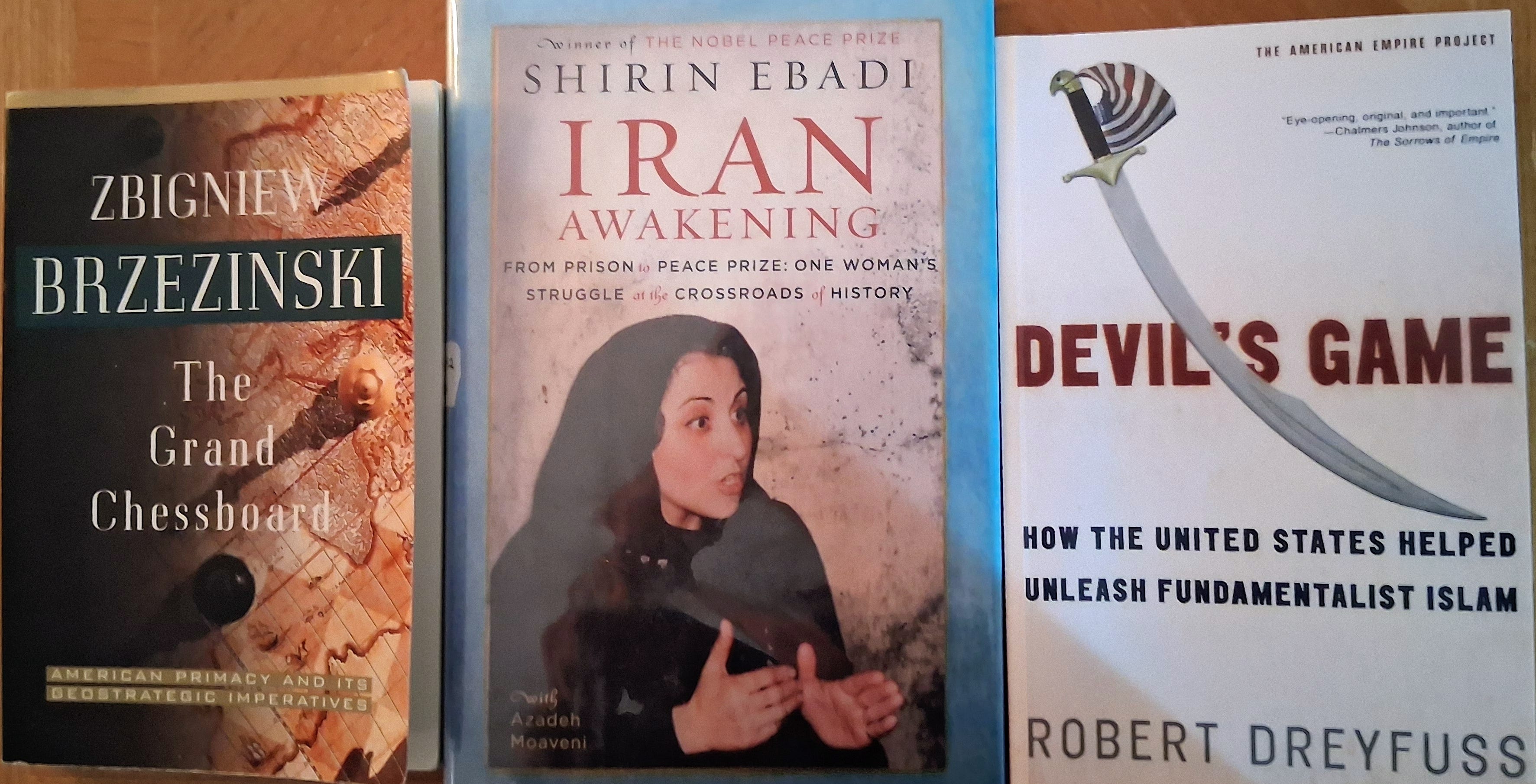
Now let me mention a few things about Iran since 1979, relying on just three books: Zbigniew Brzezinski’s The Grand Chessboard (Basic Books, 1997), Robert Dreyfuss’s Devil’s Game (Henry Holt, 2005), and Shirin Ebadi’s Iran Awakening (Knopf, 2006), assisted by Azadeh Moaveni.
Dreyfuss persuades me that the US decided not to continue supporting the Shah and, thus, escorted the radical Shi’ite leader Khomeini from Paris to Tehran. (Why ever not?) He then set up the Islamic Revolutionary Guard Corps which is still in power today.
A Global Power
I quote Brzezinski: “Hegemony is as old as mankind. But America’s global supremacy is distinctive in the rapidity of its emergence…. The Spanish American War in 1898 thrust American power far into the pacific.” (Ask the Hawaiians.) The fusion of American idealism and American power made itself fully felt on the world scene.”
Then we had the Cold War. Brzezinski himself was involved in providing training for Muslims in Afghanistan (recall the Mujahadin?) to counteract the Soviet invasion there in 1979. I mention this to drop a hint that not all Muslims terrorists are devoted to Allah. Some are mercenaries for US. And some stories about ‘Iranian terrorism’ are just stories -- as I show in my book “Inquest: Siege in Sydney.”
I note that the back cover of Dreyfuss’s book has a blurb from Salon.com: “The most clear history of the deadly partnership between Western powers and political Islam.” The description by the publisher says:
“Chronicling a history of double-dealing [what did I tell you?], cynical exploitation, and embarrassment that continues to today, Dreyfuss reveals a pattern that, far from furthering democracy or security, ENSURES A FUTURE OF BLUNDERS AND BLOWBACK.” [Emphasis added]. Dreyfuss wrote that in 2005.
Dear Reader, kindly remember that the point of this article is to get us to think about the citizen’s vote in any particular war. How can an American know what to vote for regarding the Middle East if it’s all a coverup for empire builders, actors, and money changers?
Women and Protestors
Now for Shirin Ebadi’s book. She won the Nobel Peace Prize in 2003. She had been a judge who founded the Center for Human Rights in Tehran, but by 2009 had to escape to the UK after 17 years of the IRGC’s religious tyranny. Her girlhood was secular, under the shah; it surprised her how Khoumeini’s arrival warmed people’s religious senses, including hers. In 1979 she had been thrilled by it, joining two million people on the streets. Later, things went bad:
“I read a spectacular piece of news – the introduction of the Islamic penal code would fundamentally transform everything -- the very basis of governance, the relationship of citizens to laws, the organizing principles and social contracts along which society is conducted.
“[Much later] it was becoming apparent to educated Iranians that the revolution was veering in a vicious direction. Not only were the sympathies that had brought us out into the streets absent in many of the revolutionary processes, there was an appetite for violence that seemed only to grow.
“Those arrested on charges of plotting to overthrow the regime typically faced sophisticated methods of torture that did not leave telltale marks on the body. Sleep deprivation, mock executions, foot lashings. These methods replaced the cruder physical torture employed by the SAVAK, such as nail extraction and hot grills….”
By the 21st century, the Revolutionary regime had become ridiculous in its curtailing of women’s rights. Now let’s jump over to the present to say that in 2026, the ruling Ayatollah Khamenei had thousands of prisoners killed. So yes, it’s true that there was some rejoicing when Trump had that guy assassinated.
(For the record: We torture people at Gitmo and at CIA ‘black sites.’)
The Nuclear Worry and Sanctions
If you must compose your vote for an Iran war (or diplomacy, or whatever), you will need to know how the US, and some other nations, have been strangling Iran for decades by way of “sanctions.” Part of it has to do with international agreements that restrict the spread of nuclear weaponry.
Sanctions can take the form of freezing the assets, including gold, that Iran is holding in foreign countries. It can also mean people from Iran are not granted visas when they want to travel. They are also closed out of the SWIFT system of banking that makes money transfers easy. Mainly it messes up import/export of Iranian goods.
Starting in 2006, the UN Security Council made resolutions to enforce some of these sanctions. We, and some European countries, did likewise, on the grounds that Iran had not lived up to its nuclear agreement. That is, Iran continued to enrich uranium, which indicates an intention to make a nuclear bomb.
Right now, I doubt there’ll be any UN Security Council involvement in sanctioning Iran. Russia and China are members of the top-table at the Security Council, which has a total of 15 members. Only the top five (US, UK, France, Russia, and China) have veto power. China is a major trading partner with Iran, and Russia is seeking Iran’s help against Ukraine.
Also, as Professor John Mearsheimer has pointed out on Danny Haiphong’s YouTube channel, whole new alliances are being formed among countries that were dependent on the US’s protection. Iran’s 2026 strikes on the US bases there have made those countries realize that we can’t offer them protection going forward.
Victor Hanson’s Idea
It will be obvious, especially owing to President Trump’s fumbling (and also his promises to Israel) that the interests of various nations won’t get satisfactorily settled by violence or by cute military strategies. This is the century in which brains are needed as the situation is potentially so dire.
Prof Victor Hanson, a historian in California, has come up with a prospect for the tyranny in Iran to be curtailed. He suggests that Shah Reva Pahlevi’s son could form a Government-in-Exile. That is, Western nations could say that they give semi-recognition to this Shah to look out for the rights of Iranians in Iran even though he himself could sit in, say, Canada, or South Africa.
Hanson imagines that the regime in Tehran would get the message that it’s time to stop executing people for trying to participate in politics.
In conclusion, I regret that this article passed over each historic moment so lightly. To compensate, here is a recent video made by my colleague James Perloff, who wants us to know that Sixty Minutes gave us a false impression of the Shah back in 1976:
Mary Maxwell’s would like to hear your ideas. Email: MaxwellMaryLLB@gmail.com